You walk in, drop your bag, and before you’ve even taken your shoes off, your shoulders are already up near your ears. Nothing dramatic happened today. The apartment just does that — too much visible at once, nowhere obvious for your eyes to land, a low hum of disorder you couldn’t point to one single thing to blame for.
You’ve probably assumed the fix is a redecorate you can’t afford right now, or a weekend of hauling things to donation that you keep not finding time for. Neither is actually true.
You can make your apartment feel calmer today, for free, and here’s exactly how.
Why this happens — and why buying more doesn’t fix it
Here’s what nobody tells you: a calm home isn’t a bigger home, and it isn’t a more expensively decorated one. Calm has less to do with what a space has and more to do with what your nervous system is doing while it’s in that space — and that responds to things you can adjust today, for free. Anita Yokota, one of the designers and mental health professionals AOL spoke with about calming a home without spending money, put it simply: reducing what your eyes have to process lowers the load your brain is carrying without you noticing it’s carrying anything at all.
That’s the reframe worth sitting with: you don’t need to buy calm. You need to remove what’s quietly costing you some.
The map: 7 free ways to make your apartment feel calmer
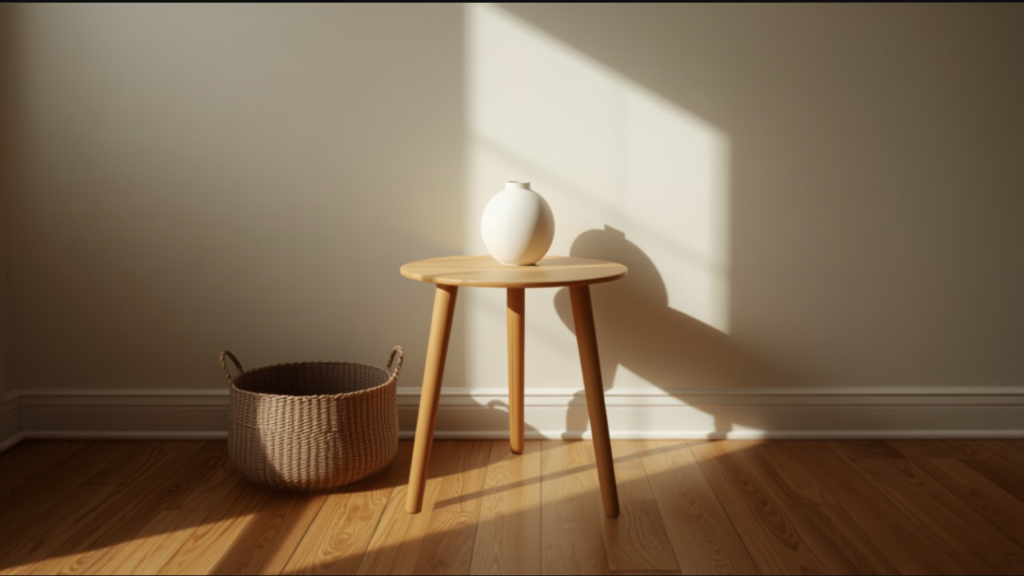
Let your eyes find one spot to land. Pick a single surface — a nightstand, an entryway table, your desk — and clear it completely. Yokota’s explanation: when visual clutter drops, your brain stops overprocessing stimuli it doesn’t need to, and that alone lowers stress hormones. Rachel Melvald, quoted in the same piece, frames it as giving the eye a place to rest: “when the eye knows where to land, it stops scanning for threats.” One clear surface does more for how a room feels than a dozen small tidying gestures spread everywhere at once.
Change the light before you change anything else. Open your curtains within the first hour of waking — Yokota notes that morning light helps regulate your circadian rhythm and even stabilizes your body’s stress-hormone patterns for the rest of the day. At night, the flip matters just as much: skip the harsh overhead light and switch to a lamp or two instead. Melvald’s read on overhead lighting at night is that it creates a kind of sensory overload that keeps your body in an activated, alert state — the opposite of what you’re going for in the hour before bed.
Let air actually move through the room. If you can open windows on two sides of your apartment, even for a few minutes, do it. Cross-ventilation increases oxygen flow, which Yokota connects directly to mental clarity and less fatigue. If your layout doesn’t allow for that, a rhythmic task involving water — washing dishes, a shower — does something similar for your nervous system in the meantime.
Put the real materials you own where you can actually see them. Wood, stone, cotton, linen, ceramic — if you own any of it, it’s probably tucked in a drawer or buried under something else. Move a few pieces to visible surfaces. Natural materials read as safe and unthreatening to your brain in a way that synthetic surfaces and clutter don’t, according to Yokota’s explanation of the effect.
Clear one category using only what you already own. You don’t need an organizing system to start — you need the “empty, categorize, place” method: pull everything out of one drawer, shelf, or cabinet, sort into what you’re keeping, and put back only that. Apartment Therapy’s room-by-room guide recommends starting in the kitchen, specifically the refrigerator — tossing what’s expired is a fast, low-effort win that builds momentum for the rest of the apartment. If you want a rule of thumb for anything you’re unsure about keeping, the 90/90 rule works well: if you haven’t used it in the last 90 days and can’t picture using it in the next 90, it can go.
Rearrange what you have so the room flows. You don’t need new furniture to change how a room moves — you need to look at what’s actually in the way. A chair angled to block a walking path, a table pushed somewhere it doesn’t need to be — small adjustments to what you already own can open up a room more than a single new object ever could.
Turn down the background noise, both kinds. Literally: if the TV or a podcast is on by habit rather than by choice, notice it, and try a stretch of actual quiet instead. And visually: if your space has five colors competing for attention, group what you already own by tone instead of buying anything new — a shelf of warm neutrals reads calmer than the same objects scattered by color across the room.
By situation
If you’re in a studio or one-room apartment. The “one clear surface” step matters even more here, because in a single room, every surface is visible from everywhere else at once. Start with whichever one you see first when you walk in the door.
If you’re renting and can’t paint or drill. Every idea above works without touching a wall — moving furniture, swapping which lamp is plugged in where, and regrouping what you own by color and material are all fully reversible. Nothing here requires your landlord’s permission.
If you share the apartment with a roommate or partner. Pick the shared surfaces — the coffee table, the entryway — as your first “clear spot” together, since those affect how calm the whole apartment feels for both of you, not just your own room.
If you’re low on time, not motivation. Do the kitchen refrigerator first, and only that, today. It’s the fastest real win on this list, and it’s usually enough to make you want to do the next one tomorrow.
You don’t need more — you need less in the way
None of this asked you to buy anything, redecorate anything, or find a free weekend you don’t have. A cleared surface, better light, a drawer that isn’t lying to you about what’s in it — that’s most of the distance between an apartment that sets your shoulders on edge and one that lets them drop the second you walk in.
You already have what you need to make your apartment feel calmer. It’s just currently covered up.