Right now, your winter coats are probably doing one of three things: draped over the one chair in your apartment that was supposed to be for sitting, stuffed into a suitcase you can’t fully zip, or living in a pile on the closet floor that you’ve started stepping around instead of dealing with. None of that is because you’re disorganized. It’s because you’re trying to fit two seasons of clothes into a closet that was only ever sized for one.
This guide shows you how to store off-season clothes without a closet, in five short steps.
Here’s the reframe: the problem isn’t your discipline. “Just put it in the closet” was never realistic advice for an apartment where the closet barely holds what you’re wearing this week, let alone what you wore last winter and won’t touch again until it’s cold.
You don’t need a bigger closet. You need a system that lives outside it — using space you already have, not space you’d have to make.
What you’ll have when you’re done
A clear, closet-free spot for every off-season piece you own, sorted so you can find anything in under a minute, using containers and space that already exist in your apartment. No new furniture required. No rearranging your whole layout. Just clothes that have somewhere to be, instead of somewhere to pile up.
What you need
Nothing you don’t already have is required to start:
- Any containers with lids — repurposed moving boxes, an old suitcase, plastic bins if you’ve got them
- Space under your bed, even if something else is currently living there
- A permanent marker or a few sticky labels
- About twenty uninterrupted minutes, which is genuinely all this takes
If you want to invest in something later — vacuum-seal bags, a proper set of matching bins — that’s an upgrade, not a requirement. None of the steps below depend on it.
The steps: how to store off-season clothes without a closet
1. Separate “off-season” from “in-between.”
Before anything goes into storage, sort what’s coming out of rotation into two honest piles: truly off-season (the coat you won’t touch again until it’s genuinely cold) and in-between (the light jacket you might still grab on a cool morning). Only the first pile gets packed away. Storing something you’ll actually reach for next week defeats the entire point.
2. Compress what you can — and know what not to compress.
For anything bulky, vacuum-sealed bags shrink volume fast if you own them or want to buy them: fold the item, seal the bag, use the pump attachment to pull the air out. No vacuum bags on hand? The “army roll” does real work for free — fold each piece lengthwise, then roll it into a tight cylinder instead of folding it flat. It takes up less room, and you can see what you’re grabbing at a glance. One exception worth knowing: skip the vacuum bags for wool, cashmere, silk, and down — compression can damage the fibers or flatten the fill for good. Those get folded, not vacuumed.
3. Claim the space under your bed before you look anywhere else.
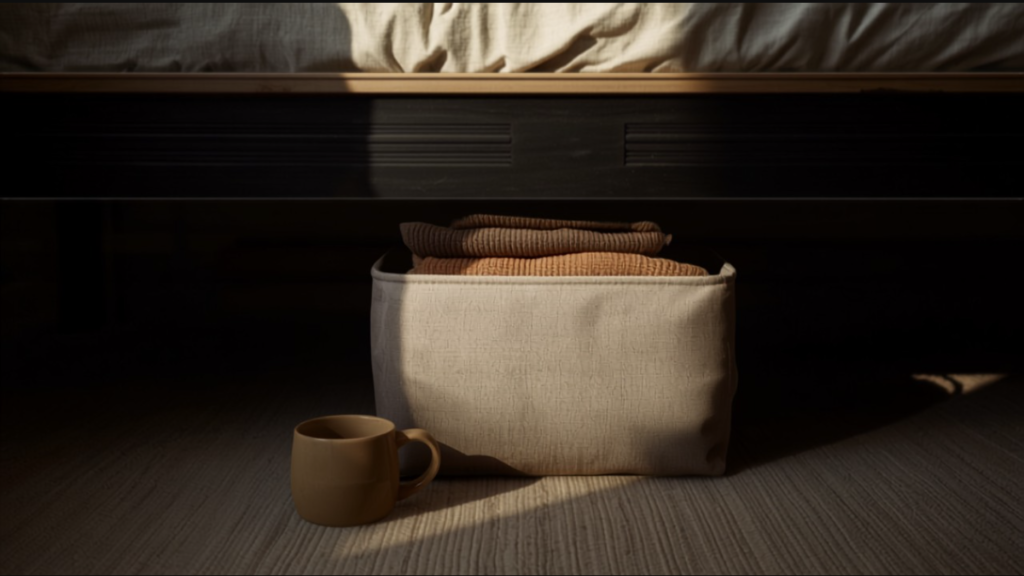
It’s the single most underused storage surface in a small apartment, and it’s already yours. Slide bins or rolled clothes underneath in something with a lid, so dust isn’t a factor. If your bed sits low, a few risers under the frame legs buy you real clearance without any tools or drilling — you’re lifting the bed, not attaching anything to it.
4. Repurpose furniture you already own before buying anything new.
An open bookshelf can hold folded stacks in baskets. The empty top shelf of a wardrobe that’s otherwise full can take a stack of sealed bags. An unused suitcase is already a lidded container — use it as one. The goal isn’t a matching storage system. It’s giving your off-season clothes somewhere specific to live, using furniture that’s already doing other jobs in your apartment.
5. Label the outside, not just the inside.
A sticky label on the end of the bin or the bag — “sweaters,” “heavy coats,” “summer” — means you never have to open three containers to find the one you need. This step takes ninety seconds, and it’s the difference between a system you actually use next season and one you quietly abandon.
By situation
If you’re short on floor space entirely. Prioritize the under-bed zone first — it’s storage you’re not using for anything else, and it holds more than it looks like it should.
If you’re storing delicate fabrics. Skip the vacuum bags for those specific pieces (see step 2) and use a breathable container instead — even a cotton pillowcase works better than plastic for something like a silk blouse.
If you share a closet with a roommate or partner. Agree on whose off-season clothes go where before you start. The ten-minute conversation now saves you from three overlapping systems that nobody can actually navigate later.
You already have the space
This isn’t about finding the right bins or the ideal closet system. It’s about noticing the space you’re not using — under the bed, the top of a shelf, a suitcase doing nothing between trips — and giving your off-season clothes somewhere specific to live. When the season changes again, the swap takes twenty minutes instead of becoming a weekend project you keep putting off. That’s all it takes to store off-season clothes without a closet.
More on making space without buying more
If storage is the theme of your week, this one covers the rest of the apartment, no drilling required: 9 Renter-Friendly Storage Ideas for Small Apartments — and most of it is free.